Answers to Acupuncture

Wednesday, September 26, 2007

How To Drink Chinese Herbal Decoctions:


"If bad taste means strong medicine, you're cured. "

Some people enjoy drinking herbal blends, but for many of us, effective doses of medicinal herbs taste bad. To make matters worse, cooking herbs can befoul your kitchen (if not your whole house). However using a little common sense can make this a lot easier.

First, while cooking herbs, ventilate the kitchen. This stops the odor from deterring you (and your family).

Hold your nose when you drink your herbs. This eliminates almost all the taste.Drink your herbs luke-warm or at room temperature. Hot liquids must be sipped slowly. If you hate the taste, just drink it down quickly. Cold liquids have less taste but may be hard to digest.

Chew a few raisins or place a drop of lemon juice on your tongue after swallowing, to eliminate the aftertaste.

Herbs usually work best when taken on an empty stomach. Allow at least a half hour after taking herbs before eating or taking additional medicines. If you are taking pills or powders, swallow them with warm rather than cold water. This will help you digest and absorb the medicine. There are some exceptions. If your medicine proves difficult to digest, try taking it with food or after eating. Some doctors believe that formulas designed for the upper body should be taken after eating. Some medicines are best taken with other liquids such as wine (injuries or vascular problems), broth (to aid digestion of the herbs), or salt water (messenger to the Kidneys). Tinctures are best diluted with a small amount of water to reduce the caustic effect of the solvents they contain. Heating these liquids can evaporate some solvent.Use a small amount steaming hot water to dissolve water extracted granules (powdered). The hotter the water, the better these dissolve. If the water is too hot, however, you'll be forced to sip your medicine. So let it cool or add a little cold water. I briefly stir in an ice cube. Instant cold without a lot of extra liquid to swallow.

Milled powders can be boiled, taken as tablets or steeped as a draught (teabag).

Monday, December 18, 2006

Neck Exercise

Neck And Glide Extension

NECK GLIDE (middle photo): Start with neck straight. Slowly slide your chin forward. Hold for five seconds and return to starting position. Do ten times. NECK EXTENSION (right photo): Without arching your back, slowly move your head backward so you are looking upward. Hold for five seconds. Return to starting position (far left photo). This is a good exercise to do during work to prevent neck strain.

-----------------------------------------------------------------------------------------------------------------------------------------
Acupressure Point
Practitioners in acupressure have various pressure points located on the body. The points shown here related to chronic pain. By pressing and holding for several seconds, acupressure advocates believe a person can sense some relief of pain.

------------------------------------------------------------------------------------------------
Neck Rotation

Start by looking straight ahead. Slowly turn your head to the left. Hold for ten seconds, then return to starting position. Then, slowly turn you head to the other side. Hold for ten seconds. Return to starting position. Do ten repetitions. This is a good exercise to do during work, especially if you have to keep your head in a steady position for extended periods, as in working at a computer. Do this exercise every half hour to prevent neck strain.

------------------------------------------------------------------------------------------------
Neck Side Extension

Start by looking straight ahead. Slowly lean your head to the left. Hold for five seconds, then return to starting position. Then, slowly lean your head to the other side. Hold for five seconds. Return to starting position. Do ten repetitions. This is a good exercise to do during work, especially if you have to keep your head in a steady position for extended periods, as in working at a computer. Do this exercise every half hour to prevent neck strain.


----------------------------------------------------------------------------------------------------------------------------------------
Neck Stretch

Start by looking straight ahead. Slowly raise both shoulders up. Hold for five seconds, then return to starting position. Do ten repetitions. This is a good exercise to do during work, especially if you have to keep your head in a steady position for extended periods, as in working at a computer. Do this exercise every half hour to prevent neck strain.


----------------------------------------------------------------------------------------------------------------------------------------

Neck Forward Flexion

Start by looking straight ahead. Slowly lower your chin toward your chest. Hold for five seconds, then return to starting position. Do ten repetitions. This is a good exercise to do during work, especially if you have to keep your head in a steady position for extended periods, as in working at a computer. Do this exercise every half hour to prevent neck strain.

Saturday, November 04, 2006

How Soon Does Acupuncture start to work

Yin Lo. Phd
How Soon Does Acupuncture start to work after you put the needle to work after you put the needle in the acupoints? Some say it works immediately, while others argue it begins to work after the needle has been pulled out. Which is the correct answer?
At a recent dinner party, one of our guests, a lady named Tah, was seated next to our friend John. After we ate our dinner, we had a heated discussion, during which John leaned backward and tilted his chair until the two front legs were up in the air. Tah then somehow slipped her feet to the place where the two chair legs had been. When John put down his chair, one of the legs landed right on Tah's toe. Her face turned white and she started to sweat. Another of our guests, my friend Dr. Chen, an acupuncturist, immediately jumped into action. Using a needle I provided, he needled her arm. Immediately, her pain was relieved, blood rushed to her face and her face looked normal again. Afterward, she said she had felt immediate relief after the needle entered her body. This anecdotal evidence suggests that when needle is used correctly, the effect is immediate.
The important question is: Is there any scientific evidence on how soon an inserted needle starts to work? We did a study on 15 patients with pain, only inserting one needle on acupoints away from the pain area. We found that in all cases, within one minute the maximum temperature at the pain area started to decrease. The effect of the acupuncture needle was almost immediate after it was inserted.
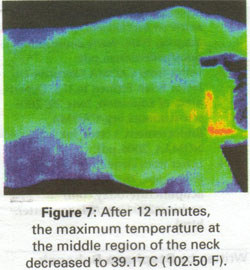
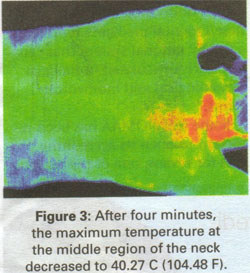
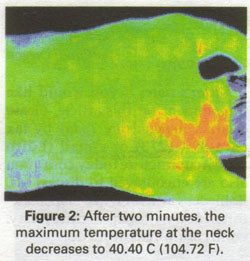
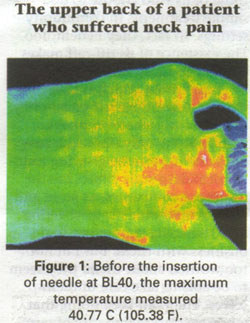
In Figures 1-9, we present a series of infrared pictures of a patient suffering from neck pain. The pictures were taken at 0-, 2-, 4-, 6-, 8-, 10-, 12-, 14- and 27-minute intervals. The color code of the infrared pictures is as follows: white for the hottest, then red, yellow,, green, blue, and the coldest in black.
We can see that the temperature of the back of the patient's neck gradually decreases. The maximum temperature at the hottest spot at back of the neck was first shown as white in color. Then it became red, yellow, and finally green. Numerically, the maximum temperature at the middle region of the neck decreased from 40.77 C(105.38F), to 40.40 C(104.72 F), 40.27C(104.48F), 39.98 C(103.96 F), 40.21 C(104.37 F), 39.27 C(102.68F), 39.17 C(102.50 F), 38.85 C(101.93 F), and 37.78 C(100.16 F), respectively, during the above-noted time sequence.
There was a total decrease of 3 degrees Celsius(4 degrees F)at this hottest spot.The normal fluctuation of temperature of the skin was known to be 0.1 degrees Celcius to 0.2 degrees Celcius.So the decrease of maximum temperature of the pare area was at least 10 times greater than normal fluctuation of skin temperature.Furthermore, the decrease of the maximum temperature in time can be fitted with an exponential curve.The half-decay time of the exponential diminishing of the maximum temperature at the pain area ranged from 6.4 minutes to 63.6 minutes for the 15 patients we studied.
The next important question is: What causes this exponential decrease of temperature in the pain area from acupuncture? Many studies have established the fact that acupuncture can increase the hormone supply of endorphin, which helps patients to endure pain. But our study suggests there is a greater increase in endorphins when inserting the needle. The effect of acupuncture is on the area where the pain originates. So, acupuncture not only makes our nerve system relatively insensitive to the pain, but it also actually changes the physiological functional of the place where the pain originates, Thus, we may have reason to believe that acupuncture not only relieves pain, but also cures the pain as well.
Why is the decrease of maximum temperature exponential? Exponential decay is quite general
in nature. If the mechanical of pain relief is of statistical nature as dictated by quantum mechanical reactions, the decay is definitely exponential.


Thursday, January 05, 2006

Acupuncture & Sciatica Pain

By Kevin Dai L.Ac.

Understanding sciatica pain

For some people, the pain from sciatica can be severe and debilitating. For others , the pain from sciatica might be infrequent and irritating, but has the potential to get worse. Usually, sciatica only affects one side of the lower body , and the pain often radiates from the lower back all the way through the back of the thigh and down through the leg. Depending on where the sciatic nerve is affected, the pain may also radiate to the foot or toes.

Be Careful If You Have One Of These Symptoms

* Pain in the rear or leg that is worse when sitting
* Burning or tingling down the leg
* Weakness, numbness or difficulty moving the leg or foot
* A constant pain on one side of the rear
* A shooting pain that makes it difficult to stand up

If you’ve had radiating leg pain and have been told that you need drugs, surgery, or worse yet, if you’re waiting for your pain to “just go away,” you need a second opinion !

You don’t have to suffer needlessly from sciatic pain and you shouldn’t depend on drug to get the relief you’re looking for. Drugs only mask the symptoms; they can’t correct your root problem.

It’s time for you to choose a more effective and safer way !

You Can Count on Acupuncture !

In Western medicine terms it has been discovered that the needling of the acupuncture points stimulate the nervous system to release endorphins which are the body's own powerful pain reducers. But it also causes the release of other chemicals and hormones in the body,
which improve energy levels , restore biochemical balance and stimulate the body's natural healing potential. All of this promotes physical and emotional well being.

What Causing Your Sciatic Pain ?

* Improper lifting
* Cumulative spinal stress
* Sudden impact or trauma
* Old injury
* A fall
* lack of exercise
* over exertion
* Poor posture

Acupressure

This therapy is based on the same principles as acupuncture, but rather than using needles , the practitioner massages or presses specific points along the meridians to effect healing . Although the results may be more subtle than with acupuncture , acupressure may be a good choice if you'd rather avoid needles .

Prevention

Some sources of sciatica are not preventable, such as disk degeneration, back strain due to pregnancy, or accidental falls . Other sources of back strain, such as poor posture, overexertion, being overweight, or wearing high heels , can be corrected or avoided . Cigarette smoking may also predispose people to pain, and should be discontinued.

General suggestions for avoiding sciatica, or preventing a repeat episode, include:
-- Sleeping on a firm mattress;
-- Using chairs with firm back support ;
-- Sitting with both feet flat on the floor ;
-- Habitually crossing the legs while sitting can place excess pressure on the sciatic nerve ;
-- Sitting a lot can also place pressure on the sciatic nerves , so it's a good idea to take short breaks and move around during the work day , long trips, or any other situation that requires sitting for an extended length of time ;
-- If lifting is required , the back should be kept straight and the legs should provide the lift ;
-- Regular exercise, such as swimming and walking, can strengthen back muscles and improve posture . Exercise can also help maintain a healthy weight and lessen the likelihood of back strain ;


Acupuncture & Frozen Shoulder

By Kevin Dai L.Ac.

Frozen shoulder is a name to describe the character of the disease, which also known as ‘Adhesive Capsulitis’. Actually frozen shoulder is the inflammation inside the shoulder or around the shoulder. It is a condition affecting people generally aged between 40 and 60 , but other ages peoples also can get the problem. Essentially, it is a “ painful and stiff ” shoulder . It is more common in people suffering from Diabetes Mellitus. Investigations such as certain blood tests and X-rays are normal. If not treated, This condition usually lasts between 6 months to 7 years, even life time suffering.

There are 3 Phases to Frozen Shoulder, each lasting several months:

1. Freezing: There is increasing pain and stiffness. The patient first complains of a painful shoulder, that ‘feels like a toothache’. This affects the sleep adversely especially when lying on the affected side . Graduallly , it gets more difficult to raise the arm sideway and to touch behind one’s head until it becomes impossible.
2. Frozen: The pain gradually subsides but the stiffness persists.
3. Thawing: The movements gradually return . However , many patients do not regain their full range of movement even after many years.

The anatomy of Shoulder

Shoulder is known as a “ suspension” joint. This type of joint makes your shoulder very
mobile and flexible. However, a “ suspension” joints also limits the strengthen of your shoulder because it has a shallow socket and very little support. The anatomy of your shoulder makes it vulnerable to injury.

Acupuncture care helps restore the strength and integrity of your shoulder’s supporting soft tissues, to keep your joints flexible and working pain-free.

Chinese Medical Treatment for Frozen Shoulder: (Scientific Acupuncture Center's Standard)

During the Freezing phase, usually patient feels serious shoulder pain, patient should receive the treatment of acupuncture as soon as possible. Besides acupuncture, cupping is a standard method too. Usually after 3~7 treatment, the shoulder pain will disappear.

Several things should be noted by the patients, during the treatment of Freezing phase , patient must avoid any kind of movement or exercise of the shoulder. Patient must avoid heat packs. Ice packs could be used, if patient suffer serious pain. Painkiller is not recommended at all.

After patient doesn't feel shoulder pain any more, exercise is still not recommended, the movement of the shoulder only happens when our doctor's treatment. After the treatment, patient should avoid any kind of exercise at home. We think the exercise of the shoulder actually delayed the recovery of the shoulder's full movement range.

Conventional Western Medical Treatment for Frozen Shoulder:

General Advice: There should be sufficient rest for both the patient and the affected shoulder. Resting the affected arm on a “Collar and Cuff” sling may help to relieve pain.
Physiotherapy: Heat, and often, Ice Packs will help in pain relief. Exercise that works through the range of shoulder movement will help if it is conducted regularly and gently. However, this should be done after the acutely painful stage has subsided. One particular exercise is the “pendulum” exercise, whereby the patient leans forward at the hip, hanging the arm down and move it in a stirring movement.
Medications: Oral painkillers such as Paracetamol and Diclofenac will help relieve the pain. Oral steroids are effective too. Occasionally, injection of steroids into the shoulder joint may be indicated.
Surgery: Manipulation Under Anaesthsia, whereby the Orthopaedic Surgeon manipulates the affected shoulder through certain movements while the patient is under anaesthesia. The result is significant pain relief and a possible shortened course of the disease process. Surgical Release can be done either through an open surgery or an arthroscope.

Wednesday, January 04, 2006

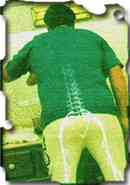
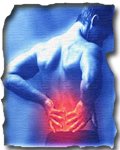
Acupuncture & Back Pain

By Kevin Dai L.Ac.

A new answer for your Back Pain
Do you know that there are as many as 85% of all Americans who will be disabled by back pain at some point in their lives? Fortunately, more and more patients have noticed a safe, effective and proven treatment method now------Acupuncture !


Oriental Medical Method:

Acupuncture--
To control the muscle spasm, stop pain, heal the injured nerves, unblock the meridians , and improve blood circulation.

Chinese Medical Massage--
To change the structure and pathological circumstances of the affected tissue, regulate and restore the tendon and eliminate the edema.

Herbs--
To build up the function of the kidney and the spleen in order to strengthen the low back muscle , assist the speed healing, and prevent the intervertebral disk problem .

Some patients rely on the pain-killing drugs, when they are in pain . However drugs
only mask the pain, but not cure the inside problems. Some patients complain that they
have seen the chiropractic for long time without obvious progress . Some patients have
even been told that they need back surgery . Please take a closer look at your options.
Many our patients have felt a great progress after several treatments , and some of them
corrected their back problems without surgery.

The results of a recent study published in the Clinical Journal of Pain provide further proof that
acupuncture is a safe and effective procedure for low -back pain, and that it can mainta in positive outcomes for periods of six months or longer without producing the negative side-effects that often accompany more traditional pain remedies.

Why the pain shouldn’t be ingored

The key to understand your back is to understand your spine. Your spine plays an important role inyour body’s health. Not only is it involed in every move you make, it also houses your body’s lifeline-your spinal cord.

Your spinal cord extends vertically through the length of your spinal through an opening in each one of your vertebrae. Your centeral nervous system, made up of your brain and spinal cord, generates electrical impulses that control and coordinate every cell, tissue, and system in your body.

Your nervous system interacts closely with your musculoskeletal system. A spinal misalignment is called a “subluxation.” Subluxation cause electrial impulses traveling along your nervous system to be slowed, lost, or confused. Muscle spasms, prolonged periods of pain, delayed recovery from injury, as well as increased chances of permanent damage and degeneration can result.

Helpful Hints for back pain :

* Adjust your desk and chair in a comfortable height
* Try sleeping on your back with a pillow under your knees, or sleep on your side with a pillow between your knees and your knees bent
* Wear comfortable, low- heeled shoes
* Avoid sitting for long periods. Get up and move around every 30 or 60 minutes.
* Don't stretch legs straight out when sitting or standing. And avoid stretching altogether as an exercise.

Saturday, December 24, 2005

Exercises for hands ( using computer too much)

Click to view big images


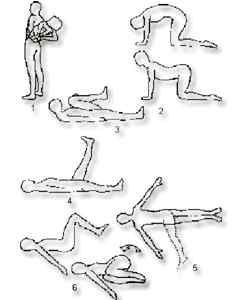
Exercise for Lower-back pain

Click to view big image

Acupuncture and Frozen Shoulder

Treatment Plus Exercise Better than Exercise Alone

By Michael Devitt, Managing Editor

The term "frozen shoulder" is used to describe a variety of conditions that cause pain and limit the range of motion of the shoulder joint. Most commonly caused by inflammation of synovial tissue or thickening of synovial fluid, frozen shoulder occurs mainly in middle-aged people who have a history of shoulder injuries. In some cases, the pain associated with frozen shoulder can be severe enough to disturb a person's sleep; in others, patients cannot rotate the shoulder properly and have difficulty moving the affected arm out and away from the body.

Once a person is diagnosed with frozen shoulder, the initial stages of care are aimed at reducing inflammation and increasing range of motion. Toward that end, various treatment methods have been devised, including anti-inflammatory drugs, ultrasound, heat, massage, and stretching and isometric exercises. Steroid injections and nerve blocks have also been employed at times, but the effectiveness of these therapies can vary greatly from patient to patient.

Several studies have reported that acupuncture can successfully treat frozen shoulder, but the majority of these studies have not been of the randomized, controlled trial (RCT) variety. A new study using the RCT format compared the use of acupuncture (along with exercise) to exercise alone in a small group of frozen shoulder patients. The study, published in the Hong Kong Medical Journal, found that patients treated with acupuncture and exercise demonstrated "significantly greater improvement" on shoulder assessment tests than those using just exercise, and suggests that acupuncture could be useful in cases where more conventional therapies have been unsuccessful.

Thirty-five adults diagnosed with frozen shoulder were randomly allocated to an exercise group or an exercise plus acupuncture group and treated for six weeks. Exercise patients participated in a standard group program of gentle stretching exercises under the supervision of a licensed physiotherapist. Treatment sessions lasted 30 minutes and were given twice a week for six weeks. In addition, patients were told to perform a series of shoulder exercises 10 times each morning, mid-day and evening at home during the trial period.

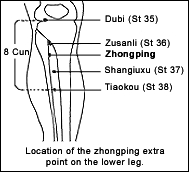
The exercise/acupuncture group followed the same home and group exercise programs as the exercise group, but also received acupuncture twice a week during the trial. A three-inch, 30-gauge needle was inserted perpendicular to zhongping, an extra acupuncture point located on the lower leg along the stomach meridian. Zhongping was chosen based on the belief that stimulating it can "improve the flow of qi across the shoulder."


A contralateral needling technique was used, in which the right-side acupoint was used for left frozen shoulder and vice-versa. The needle was inserted to a depth of 2.5 inches, followed by wide-amplitude needle rotation simultaneously with lifting and thrusting to produce de qi. The needle was retained for 20 minutes, with three one-minute needle manipulations made during the treatment period. While being needled, the patient also performed a series of functional exercises using the affected shoulder.

Subjects in both groups were assessed using a test called the Constant Shoulder Assessment, which combines patient ratings for pain and activities of daily living with range of motion measurements for a maximum score of 100 points. Assessments were taken at three intervals: baseline (just prior to the start of the study); at the completion of treatment; and at 20 weeks.

CSA scores were relatively equal for both groups at the beginning of the study. Within six weeks, however "significantly higher" scores were reported in patients receiving acupuncture and exercise, with an average improvement rate nearly twice that of the exercise-only group. These improvements were also seen at the 20 week follow-up test (see Table I).
Table I:
Constant Shoulder Assessment scores and percentage of improvement following treatment.
-------------------------------------Exercise------Exercise plus acupuncture
Group CSA score baseline ------------------- 42.8----- 41.3
CSA score 6 weeks ----------------------------57.6 ---- 66.8
CSA score 20 weeks ---------------------------57.9-----67.3
% improvement from baseline 6 weeks -----39.8% ---76.4%
% improvement from baseline, 20 weeks ---40.3%----77.2%

Despite the relatively deep needling involved in the trial, the researchers reported that no acupuncture-related complications occurred during the course of care. However, one patient in the acupuncture/exercise group discontinued treatment after the second session due to fear of needle pain.

Some limitations were noted by the investigators -- for instance, the number of exercise minutes between groups. The exercise-only group performed supervised shoulder exercises for a total of 360 minutes over the treatment period, whereas the acupuncture/exercise group performed supervised exercises for 600 minutes (360 in a group setting, 240 while being treated with acupuncture). Because acupuncture is known to relieve pain, the researchers speculated that patients who had acupuncture before exercise may have shown greater improvements because they experienced less pain during exercise. Similar concerns were raised about the size discrepancies between groups (the acupuncture/exercise group had 13 patients, while the exercise-only group had 22) and the lack of a control group to disprove the placebo effect.

Despite the limits, the researchers saw promise for the use of acupuncture in conjunction with exercise to treat frozen shoulder. "The combination of acupuncture and physical exercise may be an effective option in the treatment of frozen shoulder," they wrote. "This study provides additional data on the potential role of acupuncture in the treatment of frozen shoulder, particularly for those patients not responding well to conventional therapy." They recommended that larger, placebo-controlled trials be designed to measure short- and long-term outcomes, and that a more uniform method of defining frozen shoulder be established, which would result in valid and more reliable treatments.

Reference

1. Sun KO, Chan KC, Lo SL, et al. Acupuncture for frozen shoulder. Hong Kong Medical Journal 7(4):381-91.

Editor's note: If you would like to comment on this article, please contact Acupuncture Today by fax (714-899-4273) or e-mail (Editorial@AcupunctureToday.com). You are also encouraged to discuss this article on Acupuncture Today's online discussion forum at www.AcupunctureToday.com/forums.

Friday, December 23, 2005

Natural Painkiller Herb Pack

A must for your natural healing

Indications: For external use to improve aches and pain associated with rheumatoid arthritis , joint pain, back and shoulder pain, carpal tunnel, muscle aches, tendonitis, stomach aches including gastrointestinal distress and painful menstruation.

Nature's Way Pain Relief Herbal Packs contain only natural ingredients consisisting of high quality herbs and organics.

Check details on www.HerbPillowFactory.com

Started

From now on, I will introduce acupuncture knowledge to you and welcome check this blog all the time